Why You Snooze
✦ The Science of Waking Up ✦
Why You Can't Wake Up
In The Morning
It's not laziness. It's not weakness. It's biology — and once you understand it, fixing it is surprisingly simple.
Your Brain Has Been
Filtering Out Your Alarm.
After just a few weeks of the same alarm sound, your brain starts processing it as background noise — and hits snooze before you're even conscious. This isn't a character flaw. It's called habituation, and it affects almost everyone.
The auditory cortex — the part of your brain that processes sound — is extraordinarily good at adapting to repetitive stimuli. It's an evolutionary feature designed to help you focus by filtering out ambient noise. Your morning alarm, after enough repetition, gets filed into the same category as traffic outside your window or the hum of your refrigerator.
This means no matter how loud you make your alarm, no matter how many you set, no matter how annoying the ringtone — your sleeping brain has already learned to ignore it. You reach for snooze on autopilot, before consciousness even kicks in.
of people hit snooze at least once
The average person hits snooze 2.4 times per morning, losing 18+ minutes of meaningful sleep to fragmented dozing.
more likely to be late
People who rely on multiple phone alarms are 3x more likely to be consistently late compared to those with a single, reliable wake method.
worse sleep with phone nearby
Having a smartphone within arm's reach reduces sleep quality by up to 23% — even when it's on silent and face-down.
minute sleep cycles
Sleep happens in 90-minute cycles. Waking mid-cycle causes sleep inertia — that brutal groggy feeling that can last hours.
Your Phone Was Never Designed
To Wake You Up.
It was designed to get you to pick up your phone. The moment you reach for it to hit snooze, you're already in the app ecosystem — and that's exactly where it wants you.
Beyond the alarm itself, keeping your phone in the bedroom creates a cascade of sleep problems. Blue light from your screen suppresses melatonin — the hormone that signals your body it's time to sleep — for up to 3 hours. Low-level notifications create micro-arousals throughout the night that prevent you from reaching deep, restorative REM sleep.
The result? You spend 7-8 hours in bed but wake up feeling like you barely slept. You're not getting poor sleep because you're a bad sleeper. You're getting poor sleep because your phone is sabotaging it.
"A tap on the shoulder wakes you up even when a fire alarm wouldn't.
That's the science behind why vibration works when sound doesn't."
Why Vibration
Actually Works.
Sound and touch are processed by completely different parts of the brain. And only one of them can be trained to ignore your alarm.
Your auditory cortex is built to adapt. That's why you stop hearing background noise after a few minutes in a new environment. Your sleeping brain applies the same logic to your alarm — especially after weeks of the same sound at the same time.
The somatosensory cortex — which processes touch and physical sensation — works on a different principle. Direct physical contact on your skin cannot be habituated in the same way. This is why you immediately wake up when someone gently shakes your shoulder, even in deep sleep, but can sleep through a distant alarm going off for minutes.
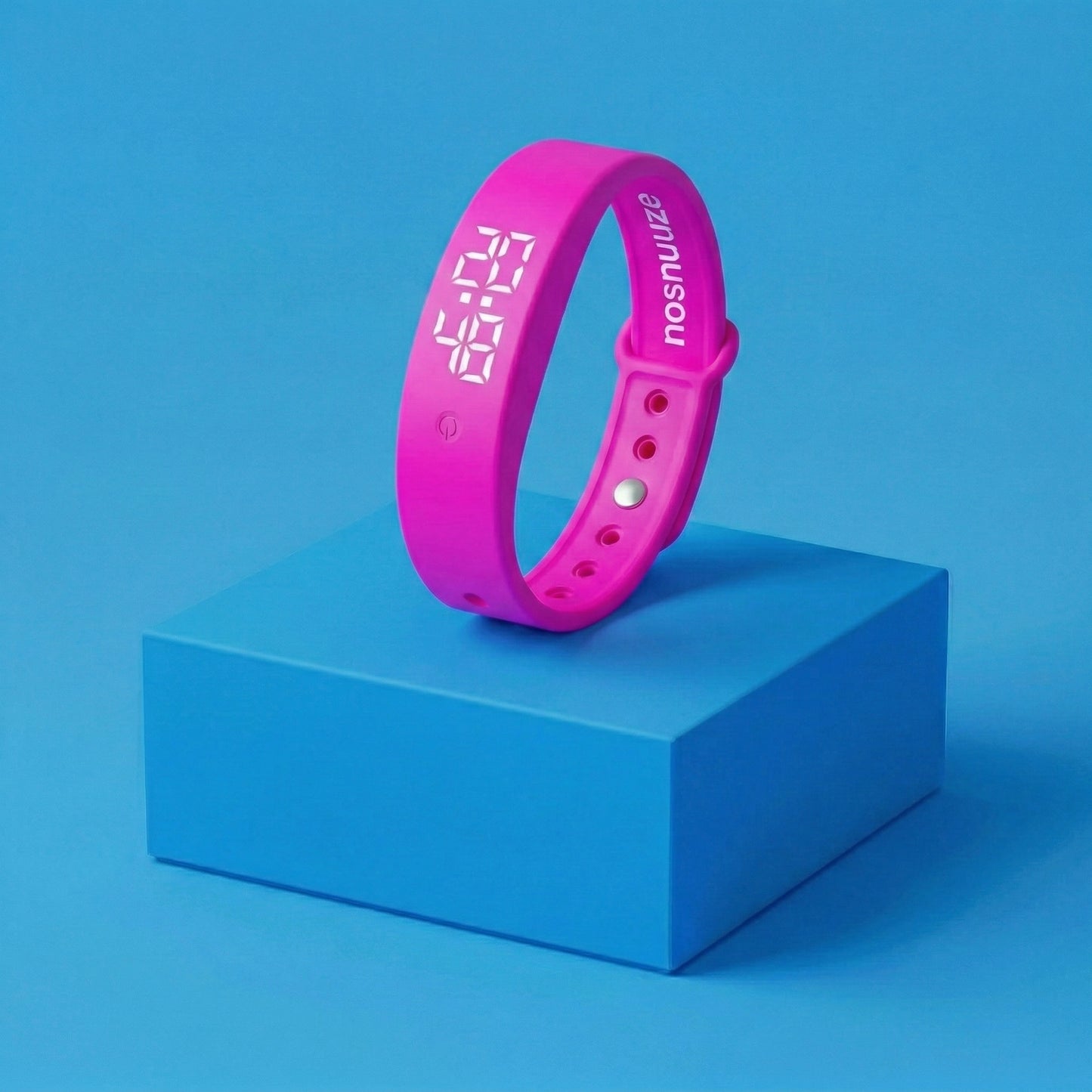
A vibrating alarm on your wrist delivers that shoulder-tap sensation directly to your nervous system — and it escalates in intensity until you're fully awake. No sound. No light. Just you, waking up on time.
The alarm triggers on your wrist
The Wake Band begins a gentle vibration pattern at your set time. No sound reaches your partner, your roommate, or anyone else in the room.
Your somatosensory cortex activates
Unlike sound, the physical sensation on your wrist goes directly to the part of your brain that cannot tune it out. Your nervous system registers it immediately.
Intensity escalates until you wake
The vibration builds progressively — starting gentle and increasing — so you wake naturally rather than being jolted. No sleep inertia. No grogginess.
Your phone stays out of the bedroom
No app. No Bluetooth. No reason to have your phone anywhere near you. Better sleep from night one — for you and everyone who shares your space.
Still Not Sure?
Ready To Actually
Fix Your Mornings?
The science is clear. The solution exists. The only thing left is to try it — risk free.
Get The Wake Band →


The Wake Band
The Wake Band


LIMITED OFFER
70% of Customers Add these

Charger

Storage case
Trusted by 10,000+ Sleepers just like you.